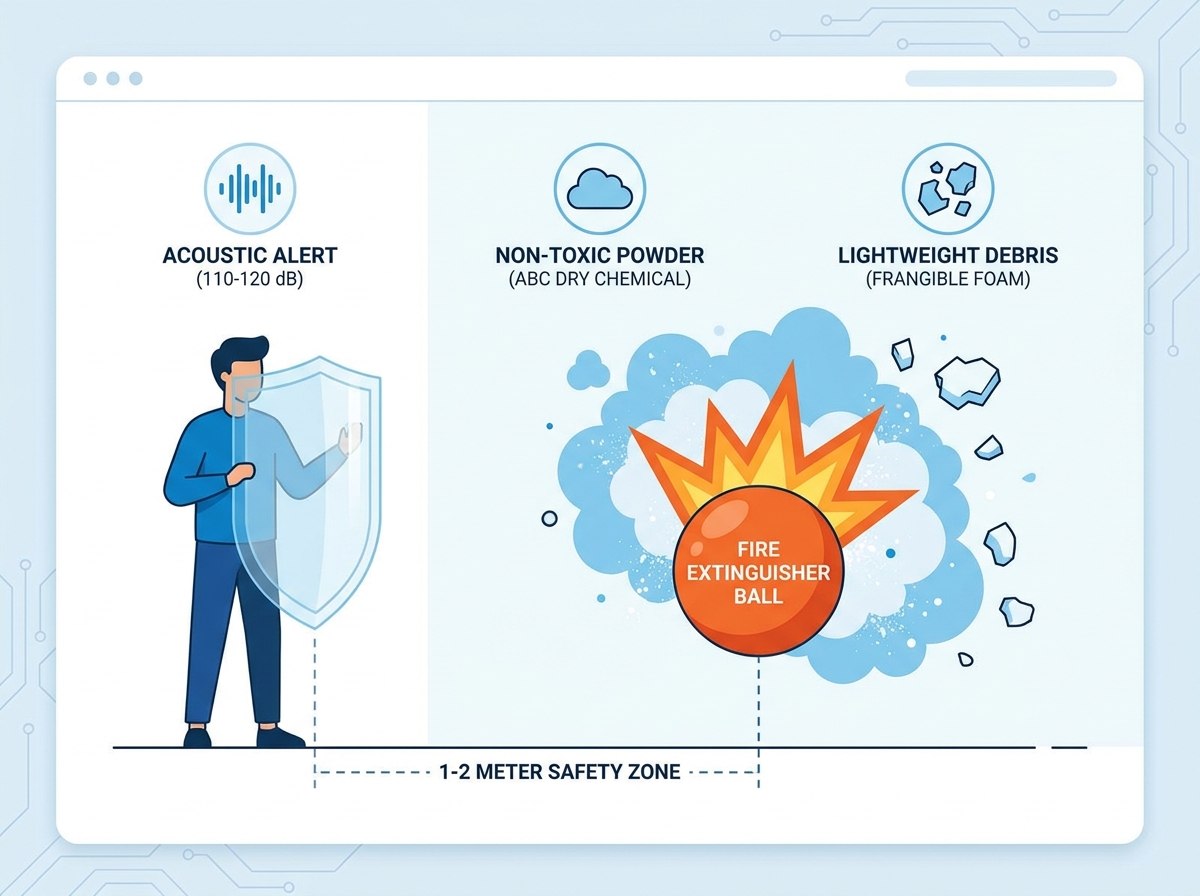
Property owners and facility managers face a core dilemma when upgrading emergency systems. A Fire Extinguisher Ball offers automated, rapid deployment, but its explosive trigger mechanism introduces valid safety and liability concerns for nearby occupants. We must establish an objective baseline to evaluate these tools properly. While the explosion is deliberately designed to disperse fire retardant instantly, it inherently generates concussive force, sudden loud noise, and a cloud of airborne chemicals. You might wonder if this rapid reaction poses hidden dangers to people. This guide provides an evidence-based breakdown of the physical and chemical impacts on the human body. You will explore acoustic risks, toxicity data, and blast mechanics in detail. Ultimately, this information helps facility managers and homeowners make informed, risk-aware purchasing decisions without compromising occupant safety.
Key Takeaways
Physical Impact: The outer casing is typically made of lightweight, frangible foam; the kinetic impact of debris is negligible, but safe distance (usually 1-2 meters) is recommended to prevent startle injuries.
Chemical Exposure: Most reputable balls use ABC dry chemical powder (Monoammonium Phosphate), which is non-toxic but can cause mild respiratory and eye irritation upon close exposure.
Acoustic Risk: The explosion generates an impulse noise (often 110–120 decibels) designed as a fire alarm, which can cause temporary ringing but rarely permanent hearing damage.
Compliance Reality: Not all products are equal. Safety heavily depends on purchasing certified devices, as unverified knock-offs have prompted official consumer safety warnings (e.g., CPSC) regarding reliability and safety.
The Mechanics of the Blast: What Happens During Activation?
Understanding the exact activation mechanics helps you evaluate occupant safety objectively. People often worry about accidental detonations. They fear a dropped device might explode unexpectedly. However, the triggering mechanism relies entirely on sustained thermal thresholds rather than kinetic impact.
Activation requires direct contact involving naked flames. Ambient heat alone will not trigger the internal detonator. The surrounding flames must typically reach 70°C (158°F) or higher. Furthermore, this intense heat must sustain contact for three to five seconds. Because of these specific thermal requirements, accidental deployment from falling off a shelf remains highly unlikely.
Once the thermal threshold is met, the explosive dispersal begins. An internal micro-detonator ignites. This tiny charge creates a rapid, 360-degree expansion. The explosive force is absolutely necessary for the device to function. It forces the internal powder outward to cover a three-to-five cubic meter radius instantly. This rapid chemical blanket smothers the fire by interrupting the chemical chain reaction.
We must also evaluate the acoustic impact. The sudden detonation produces an impulse noise. This blast often reaches 110 to 120 decibels. You can compare this volume to a thunderclap or a close-proximity ambulance siren. Manufacturers frame this loud pop as a dual-purpose feature. First, the energy disperses the heavy chemical powder. Second, the noise acts as a localized, high-decibel fire alarm to alert nearby occupants.
However, this acoustic feature introduces a specific implementation risk. The sudden noise causes a severe startle effect. You must consider how this startle response impacts vulnerable populations. Children, the elderly, or individuals having sensory sensitivities may experience extreme panic. Placing these devices in highly populated residential zones requires careful acoustic consideration.
Chemical & Toxicity Risks: Is the Dry Powder Dangerous to Inhale?
Chemical exposure remains a primary concern for homeowners. When the shell bursts, it creates a dense chemical cloud. You need to know exactly what this cloud contains. Authentic devices typically utilize Monoammonium Phosphate. Industry professionals widely refer to this as ABC dry chemical powder. It safely smothers Class A, B, and C fires.
Medical and toxicology experts maintain a clear consensus regarding this chemical agent. General poison control data states the powder is effectively non-toxic. It is non-lethal to humans and pets. However, experts classify the fine particulate matter as a localized irritant. Because the powder expands rapidly, anyone standing nearby will experience sudden exposure to the dust.
If you face close-range exposure, you will likely observe specific physiological reactions. Understanding these reactions helps you prepare proper safety protocols. The symptoms remain temporary but they do require immediate attention.
Common Physiological Reactions to Dry Chemical Powder
Exposure Route
Physiological Reaction
Immediate Mitigation & First Aid
Respiratory
Mild coughing, sneezing, or temporary shortness of breath if inhaled directly.
Move the affected person to fresh air immediately. Allow normal breathing to clear the airway.
Ocular (Eyes)
Redness, tearing, and mild stinging as dust enters the eyes.
Flush eyes gently using clean, lukewarm water for several minutes. Do not rub the eyes.
Dermal (Skin)
Minor skin drying or localized irritation upon prolonged contact.
Wash the exposed skin using mild soap and water. Apply standard moisturizer if dryness persists.
We base these mitigation strategies on worst-case scenarios. Transparent assumptions dictate we prepare for direct facial exposure. The standard first aid procedures focus entirely on basic flushing and fresh air. Because the powder acts only as a physical irritant, it does not poison the bloodstream. You do not need specialized chemical antidotes. You simply need to remove the physical dust from the body.
Physical Impact: Can Shrapnel or the Blast Force Cause Injury?
Many buyers hear the word "detonator" and immediately envision hazardous shrapnel. This fear stems from traditional explosives involving metal casings. However, legitimate suppression devices use entirely different construction materials. Analyzing the casing material reveals why the physical impact remains minimal.
Manufacturers construct the outer shell using Expanded Polystyrene (EPS) foam. They wrap this lightweight foam inside a thin PVC shrink-wrap. When the micro-detonator fires, this foam shell shreds instantly. The resulting debris consists purely of tiny, weightless foam fragments and torn plastic film.
A kinetic energy assessment confirms the safety of these materials. The shredded foam lacks the mass and density required to inflict blunt-force trauma. The pieces cannot cause lacerations to human skin. Unlike metal or hard plastic, the EPS foam absorbs its own kinetic energy as it breaks apart. The "shrapnel" simply bounces off exposed skin harmlessly.
The blast wave itself requires evaluation. The concussive force primarily serves to push heavy powder outward. It is not designed to shatter physical structures. The overpressure from a Fire Extinguisher Ball will not knock a person over. However, proximity matters greatly. If you stand within one meter of the detonation, you will feel a sudden pressure change. This pressure shift can cause minor physical discomfort. Safety guidelines recommend maintaining a distance of at least one to two meters from the installation zone to prevent startle injuries and pressure discomfort.
Common mistakes occur when users place the device too close to regular human activity. While the blast force will not break bones, the sudden pop near someone's head creates unnecessary distress. Proper mounting distances easily eliminate this physical risk.
Navigating CPSC Warnings and Product Certifications
Market reality forces buyers to exercise extreme caution. The internet is flooded by unbranded, unregulated imports. These cheap knock-offs fail to extinguish fires reliably. Worse, they often use substandard, harder casings posing elevated physical risks. We must address the recent consumer protection warnings directly.
Agencies like the Consumer Product Safety Commission (CPSC) have issued official alerts regarding unreliable products. The CPSC warns consumers about devices failing to trigger during active fires. Unregulated items may also trigger inconsistently, putting occupants in severe danger. Safety heavily depends on purchasing certified devices from reputable sources.
You must apply strict evaluation criteria when selecting a product. Do not rely on marketing claims alone. Verified documentation separates authentic safety tools from dangerous counterfeits.
Verify Local and Global Certifications: Look closely for legitimate CE marks. Ensure the product complies with RoHS standards. Authentic manufacturers undergo specific localized fire safety testing credentials.
Demand Material Transparency: Authentic brands openly publish their Material Safety Data Sheets (MSDS). The MSDS explicitly details the chemical makeup of the powder. If a seller refuses to provide an MSDS, you should abandon the purchase immediately.
Check Warranty and Liability Coverage: Verified brands offer commercial warranties. They carry liability insurance to protect end-users. You must avoid products featuring anonymous manufacturing origins. A lack of corporate accountability usually indicates a substandard product.
Trust and transparency serve as your best defense. A certified device undergoes rigorous testing to ensure the foam shatters safely and the powder deploys effectively. Skimping on certifications exposes your facility to extreme liability.
Decision Framework: Safe Implementation and Shortlisting Logic
Purchasing a certified device solves only half the problem. Safe implementation requires a strategic deployment plan. You must identify ideal deployment zones offering high return on investment while minimizing human risk.
Ideal placement focuses on unoccupied, high-risk areas. You should mount these devices inside electrical panels, where wiring faults frequently occur. Server rooms provide excellent locations due to constant heat generation. Engine compartments in boats or heavy machinery also benefit greatly from automated suppression. Finally, storage closets housing flammable liquids serve as perfect, low-traffic installation zones.
Commercial kitchens often utilize overhead mounts. However, you must only implement this when all kitchen personnel receive proper training regarding the sudden noise and powder deployment.
Risk management dictates you must actively avoid certain placements. You should never place these devices directly above beds. Avoid mounting them in highly trafficked, low-ceiling hallways. Confined spaces frequently occupied by pets or infants represent terrible locations due to the severe startle effect and sudden dust cloud.
You must firmly adopt the "Supplement, Not Substitute" rule. A passive, automated device acts as a supplementary safety tool. It does not replace the legal need for traditional, active ABC fire extinguishers. It does not negate the practical need for standard suppression systems in residential or commercial settings. Building codes still require traditional extinguishers.
Your next steps require clear action. First, evaluate your facility to identify specific, unoccupied fire risks. Second, shortlist two or three certified brands providing clear MSDS documentation. Third, audit your intended mounting locations to ensure humans remain at least one meter away during normal daily activities.
Conclusion
The final verdict clearly supports the safety of verified devices. The explosion of a certified fire extinguisher ball remains inherently safe for humans. Manufacturers design the device to prioritize rapid fire suppression over temporary physical comfort. While the sudden detonation is undeniably loud and the resulting chemical powder acts as a mild irritant, the event is not lethal. The lightweight foam casing poses no physical destruction to the human body.
We encourage buyers to audit their high-risk, unoccupied spaces immediately. Identify your vulnerable electrical panels and storage rooms. Invest your budget only in well-documented, compliant fire safety products carrying proper certifications. By implementing these passive tools strategically, you enhance your overall fire response strategy while ensuring the absolute safety of every occupant.
FAQ
Q: Can a fire extinguisher ball go off by accident if I drop it?
A: No. They are thermally activated by sustained open flames, not kinetic impact. The outer shell requires continuous exposure to high temperatures (typically around 70°C/158°F) for several seconds before the internal detonator triggers.
Q: Is the powder safe around household pets?
A: Similar to humans, it is non-toxic but irritating. Pets should be removed from the area to avoid respiratory distress until the powder is cleaned up. The fine dust can cause temporary sneezing or red eyes in animals.
Q: How do you clean up the powder after it explodes?
A: Vacuum or sweep the area while wearing a basic N95 mask and gloves to prevent localized skin and lung irritation. Once you remove the bulk powder, use a damp cloth to wipe down remaining dusty surfaces.
HUIZHOU TENYU FIRE-FIGHTING TECH CO.,LTD. are comprehensive and specialized manufacturing enterprise integrating research and development, production and sales. TENYU TECH has always...