Traditional fire extinguishers look incredibly safe on paper. Reality tells a completely different story during sudden outbreaks. Panic takes over almost immediately. Lack of proper emergency training delays crucial action. Furthermore, humans must be physically present to operate these heavy steel cylinders. This severe limitation drives modern decision-makers to seek better options. Leaders in residential, commercial, and fleet sectors actively evaluate automatic, passive fire suppression alternatives. They need systems functioning independently from human intervention.
We will objectively analyze how these alternative systems bridge critical safety gaps. This guide focuses strictly on practical implementation. You will learn the exact mechanisms behind these devices. We will also cover real-world deployment strategies and compliance realities. The upcoming sections will help you determine if a Fire Extinguisher Ball is the correct, compliant, and practical choice for your specific risk areas. Our goal is actionable clarity.
Key Takeaways
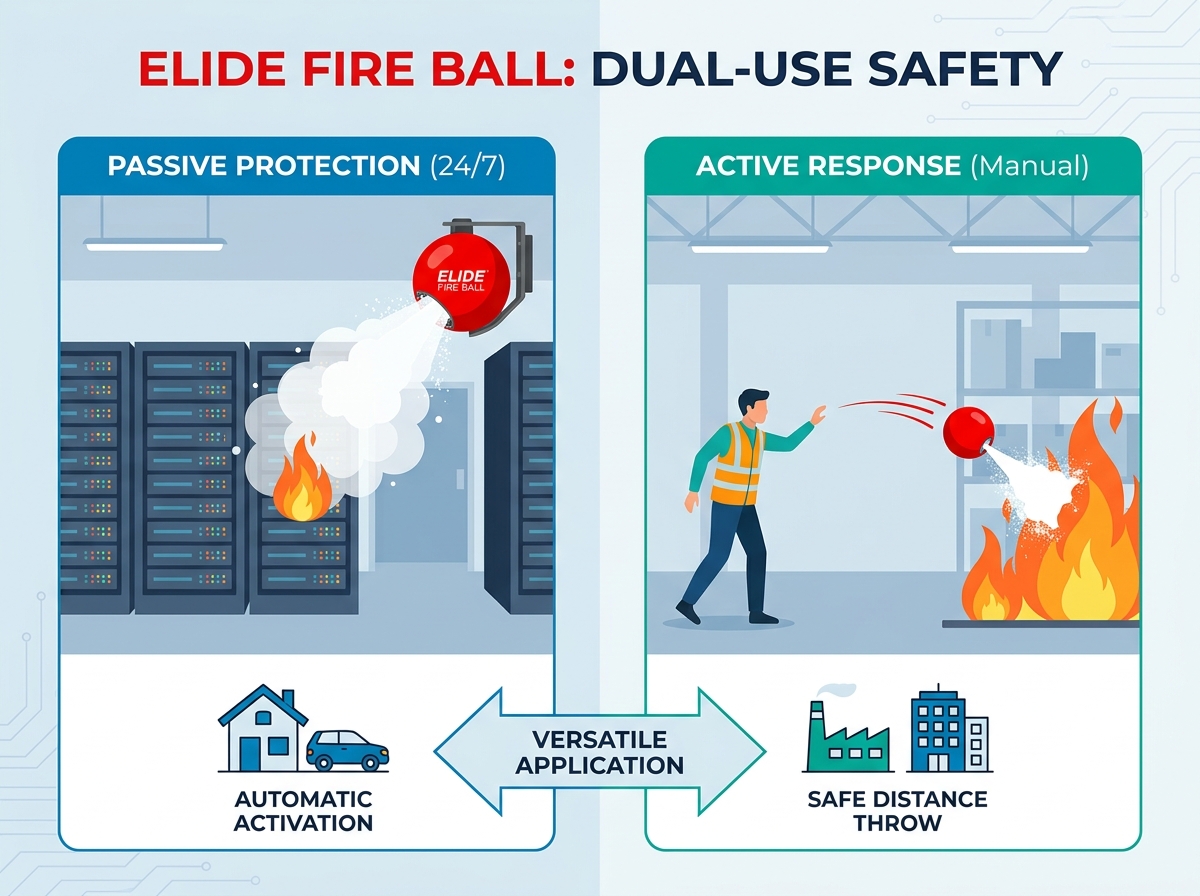
Passive & Active Dual-Use: The Elide Fire Extinguisher Ball activates automatically upon direct contact with flames, providing 24/7 suppression even in unoccupied spaces.
Use Case Specificity: Highly effective for isolated high-risk zones (electrical panels, engine bays, server rooms) across homes, businesses, and vehicles.
Quality & Authenticity Matters: Differentiates from generic alternatives through patented activation mechanisms, optimal Monoammonium Phosphate (MAP) concentrations, and proven reliability.
Compliance Reality: Functions as a highly effective *supplementary* safety device; it does not replace legally mandated traditional extinguishers for OSHA/NFPA compliance in commercial settings.
The Gap in Traditional Fire Safety Protocols
Standard fire safety setups contain inherent weaknesses. We rely heavily on manual suppression tools mounted on walls. These manual tools assume ideal conditions during a crisis. Standard protocols expect someone to notice the smoke instantly. They also assume the observer possesses the physical strength to carry a heavy metal cylinder. This framework ignores the chaotic reality of actual emergencies.
Traditional cylinders demand an active operator. This person must remember basic training under extreme stress. Safety experts teach the PASS method: Pull, Aim, Squeeze, and Sweep. Unfortunately, untrained individuals frequently forget these steps. They might pull the trigger without removing the safety pin. They often aim at the flames instead of the fuel source. Physical proximity presents another massive barrier. You must stand dangerously close to the danger zone to deploy the chemical agent effectively. Heat and toxic smoke easily push operators back before they can suppress the threat.
Most devastating electrical or engine fires start when rooms remain unattended. Warehouses sit empty overnight. Server rooms rarely see foot traffic. Vehicles park in isolated garages. When an electrical fault sparks in an unoccupied space, manual extinguishers provide zero protection. The flames multiply freely. They destroy property unchecked until smoke alarms finally summon professional responders. By then, the damage is usually catastrophic.
Commercial extinguisher fleets also demand constant oversight. Facilities managers face strict maintenance routines. They must schedule annual inspections. They coordinate pressure-testing and hydro-testing for dozens of cylinders. Employees must verify tags monthly. This administrative burden distracts safety teams from identifying new hazards.
How the Elide Fire Extinguisher Ball Actually Works
The device operates on a simple but highly engineered technical trigger. Activation strictly requires direct contact with naked flames. These flames typically need to reach 85°C (185°F). When flames lick the exterior shell, they ignite a specialized micro-cord wrapped around the device. This cord acts as a rapid fuse. It triggers a small, safe internal detonator. The casing instantly bursts outward. It disperses the dry chemical agent in a rapid 360-degree radius. The entire process takes merely three to five seconds from the moment flames touch the unit.
This rapid dispersion mechanism creates an instantaneous suppression cloud. It knocks down flames by interrupting the chemical chain reaction. The core suppressing agent is Monoammonium Phosphate (MAP). MAP serves as an exceptionally versatile dry chemical powder. It coats surfaces and melts slightly to form a protective barrier against oxygen. This chemical composition proves highly effective against multiple threat categories:
Class A Fires: Ordinary combustibles including paper, wood, cloth, and plastics.
Class B Fires: Flammable liquids including gasoline, diesel, solvents, and oil.
Class C Fires: Energized electrical equipment including server racks, breaker boxes, and machinery wiring.
Skeptics often worry about accidental deployment. Many fear placing an automatic device near warm machinery. We must address this trust gap directly. Ambient heat cannot trigger the mechanism. You could place it inside a hot car during a summer heatwave safely. Drops, kicks, or physical impacts will not trigger the device. Direct flame contact remains the only activation method. This strict requirement ensures maximum reliability. It prevents messy false alarms while guaranteeing readiness during a genuine crisis.
Evaluating Use Cases: Homes, Businesses & Vehicles
You must map out high-risk zones carefully before installation. Strategic placement determines success. We will explore specific environments to guide your deployment strategy.
Residential Deployment
Homeowners benefit immensely from passive protection. Most household fires originate in predictable locations. High-value placement areas include the space directly above kitchen stoves. You can also mount units inside garages near workbenches or paint storage cabinets. Placing a Fire Extinguisher Ball adjacent to your home breaker box provides excellent electrical fault protection.
Success criteria for residential use revolve around early intervention. The device aims for immediate suppression of common household fires. It frequently extinguishes the threat before smoke detectors even alert the local fire department. This early action prevents structural damage. It keeps escape routes clear for family members sleeping nearby.
Commercial & Industrial Operations
Businesses face complex hazards requiring robust defenses. Commercial operations feature high-voltage equipment and continuous operation cycles. High-value placement areas include dense server rooms housing critical IT infrastructure. CNC machinery panels represent another excellent deployment zone. Battery charging stations for forklifts and chemical storage closets also demand constant, passive overwatch.
Scalability becomes crucial in massive facilities. Warehouses utilize multi-ball setups for larger square footage. Facility managers arrange them in grid patterns above high-risk storage aisles. Common commercial mistakes include placing units too high above the hazard. Always ensure flames can easily reach the device before the fire spreads horizontally.
Automotive & Fleet Vehicles
Vehicles introduce unique challenges regarding vibration and airflow. High-value placement areas primarily involve engine bays. Classic car owners utilize them to protect irreplaceable investments. RV owners install them near onboard generators. Commercial transit vans and marine engine compartments benefit heavily from automated suppression.
Practical considerations dominate vehicle deployments. You must secure the bracket against intense vibration. Transit turbulence can dislodge improperly mounted units. Mount the bracket securely to the firewall or hood interior. Ensure moving belts or cooling fans cannot strike the casing.
Elide vs. Generic Fire Extinguisher Balls: A Buyer’s Framework
The market features numerous substandard knock-offs. Buyers must avoid these cheap alternatives to ensure genuine protection. We outline specific evaluation dimensions to help you navigate product selection.
Table: Evaluation Framework for Fire Suppression Spheres
Heavily diluted agents mixed with cheap fillers like talc or sand.
Casing Material
Premium Expandable Polystyrene (EPS) engineered for even bursting.
Brittle plastics or weak foams prone to cracking or shrapnel generation.
Activation Speed
Reliable 3 to 5-second response upon direct flame contact.
Inconsistent fuses causing dangerous delays or complete failures.
Certifications
Verified international patents and credible safety certifications.
Counterfeit CE marks and absence of independent testing data.
Agent concentration dictates actual suppression power. Genuine units use a highly refined, high-concentration MAP powder. This purity guarantees effective chemical interruption of the fire triangle. Cheap alternatives utilize heavily diluted agents. They compromise safety to lower manufacturing costs.
You must also evaluate the structural integrity of the casing. Genuine products utilize Expandable Polystyrene (EPS). This specific material bursts evenly. It creates an effective, symmetrical suppression cloud. More importantly, EPS prevents shrapnel damage. Cheap plastics can shatter into dangerous projectiles during deployment.
Finally, always verify patents and certifications. Look for credible safety testing from recognized laboratories. Genuine patents establish true authoritativeness. They prove the manufacturer invested in rigorous research and development. Ignoring these credentials invites devastating failures during real emergencies.
Implementation Realities, Compliance, and Known Limitations
We must address compliance transparently. For commercial businesses, automatic extinguishing spheres remain strictly supplemental. They drastically enhance your safety posture. However, they do not fulfill standard OSHA or NFPA requirements. Commercial buildings must still maintain traditional, wall-mounted manual extinguishers. Never throw away your mandated cylinders. Treat passive devices as an added layer of defense, not a legal replacement.
Experience dictates we acknowledge the cleanup factor. Dry chemical dispersion creates a mess. MAP powder is incredibly effective at stopping fires. Unfortunately, it acts corrosively toward sensitive electronics if left uncleaned. It absorbs moisture from the air and eats into circuit boards. You must implement a strict post-deployment cleanup protocol. Vacuum the powder immediately using a HEPA filter. Wipe down all exposed metal surfaces and electronic components with isopropyl alcohol. Swift cleaning prevents secondary equipment loss.
Understand the lifespan and maintenance realities. These units provide a firm 5-year maintenance-free lifespan. You do not need to check pressure gauges. You skip annual hydro-testing. Once the five-year expiration date arrives, you must properly dispose of the unit. Do not toss it into household trash. Check with local waste management authorities regarding dry chemical disposal. Replace the expired unit immediately to maintain your defensive perimeter.
Shortlisting Logic & Next Steps for Your Setup
Calculating your specific needs requires basic math and strategic thinking. Use a structured framework for sizing your purchase. Manufacturers typically recommend mapping one ball per specific cubic meter of high-risk space. For example, a single standard unit effectively covers roughly 3 to 5 cubic meters (100 to 175 cubic feet). Larger server rooms demand multiple units spaced evenly above the equipment racks.
Placement strategy heavily influences real-world performance. Follow best practices for bracket installation carefully. Height matters immensely. Place the unit 10 to 30 centimeters (4 to 12 inches) directly above the most likely ignition source. Maintain enough clearance space around the bracket. You want the fireball to expand outward without hitting immediate structural blockages. Ensure the fuse lines face downward toward the anticipated flame zone.
Take actionable next steps to secure your facility:
Audit your property to identify high-risk, low-visibility areas first.
Measure the cubic volume of these isolated danger zones.
Calculate the total number of units required based on volume rules.
Review the bracket mounting stability before rolling out a facility-wide deployment.
Conclusion
Our core thesis remains simple. The Elide Fire Extinguisher Ball effectively bridges the dangerous gap between sudden fire ignition and human response. It eliminates the fatal delay caused by panic and physical absence. It removes the necessity for perfect human execution during a terrifying event.
When you deploy these devices strategically alongside traditional safety measures, you gain unparalleled passive protection. They watch over your most vulnerable assets 24/7. Always remember their supplemental nature in commercial settings. Respect the post-deployment cleanup requirements. By auditing your high-risk zones today, you can implement a foolproof, automated defense layer that acts decisively when humans cannot.
FAQ
Q: Will the fire extinguisher ball explode if left in a hot car during summer?
A: No. The activation mechanism strictly requires direct contact with naked flames reaching approximately 85°C (185°F). Ambient heat from severe summer weather, direct sunlight, or a hot engine block will not trigger the internal fuse.
Q: Is the dry chemical powder toxic to humans or pets?
A: Monoammonium Phosphate (MAP) is non-toxic and eco-friendly. It does not poison humans or animals. However, the fine powder can act as a mild respiratory irritant during active dispersion. Evacuate the area during a fire and ventilate thoroughly before cleaning.
Q: Does installing these reduce commercial insurance premiums?
A: It depends on your provider. Because they are considered supplemental devices outside standard NFPA mandates, premium reductions are not guaranteed. Advise consulting directly with your underwriters to see if passive suppression enhancements qualify for specific discounts.
Q: Can I throw the ball directly into an active fire?
A: Yes. Throwing or rolling the device into an active fire serves as a highly effective manual deployment method. It provides a safer alternative to approaching intense heat with a traditional manual cylinder. It bursts within seconds of hitting the flames.
HUIZHOU TENYU FIRE-FIGHTING TECH CO.,LTD. are comprehensive and specialized manufacturing enterprise integrating research and development, production and sales. TENYU TECH has always...